Saturday, 12 March 2016

Great Northern War bash with painted figures

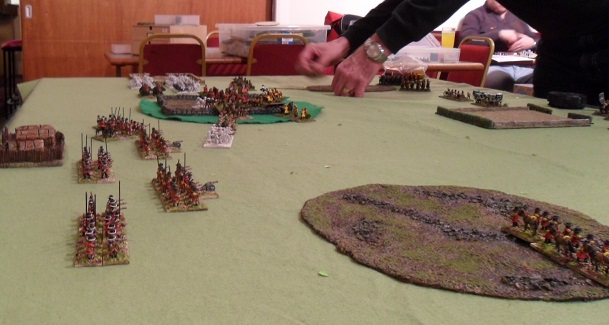
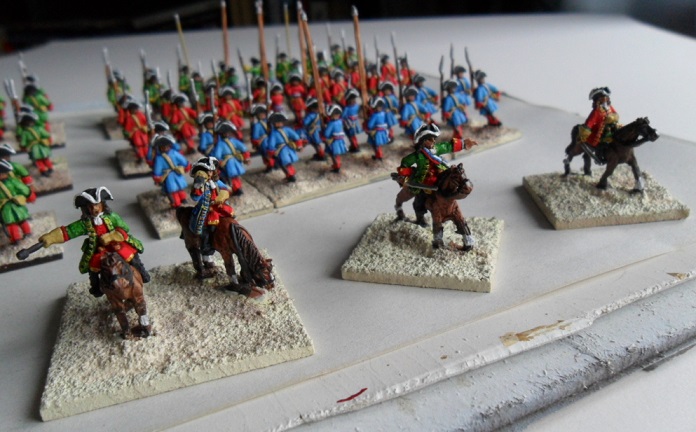
At last, and with much cheering, here is the first game using my fully painted Great Northern War figures and using the Maurice rules. I worked out two 100 point armies for this game. 

There are quite a few photos as I'm very happy to see the painted figures on the table. 

Here's my Swedish set up.  Three cavalry on the right, 8 infantry and two guns in the centre. Also visible are the measuring sticks I made up in bands the national colours - blue and yellow for the Swedes.  Everything in Maurice is measure in terms of base-widths and the sticks make it easy to measure move distances and ranges.   


Here's the Russian line.  8 infantry and three guns in the centre.


The Russian left of three cavalry and a noble commander.  The noble's card is at the back of the table, but I can't remember now who he was.  


The Russian right three cavalry.  The Russian measuring sticks are in the background. I did these sticks in bands of red, blue, white and green. 


The Russian infantry centre. 

The game started with a couple of bombardments, then the Swedish infantry moved forward.  And then, in one of the brilliant things that can happen in Maurice, my opponent played an interrupt card "That's not on the map" and a marsh became visible in front of some of my infantry.  After much laughter from everyone round the table, I started to move my second rank units around he marsh.  

Also, as the game played out, this proved to be one of the decisive moments in the game as it split my infantry force and my attack.    


The Swedish centre approached the Russians line but the front unit suffered 4 Disrupts. I was able to rally this unit with another great card, but the combination of Russian musketry and canister took it's toll. 


Here is the Swedish centre after the combats. One bold regiment is pushing into the Russian line but the other units have routed.  The C-in-C at the bottom of this picture now has to re-arrange the second line and the units that were delayed by the marsh. 


In a good move, the Russians advanced his cavalry around the wood to threaten the Swedish flank.
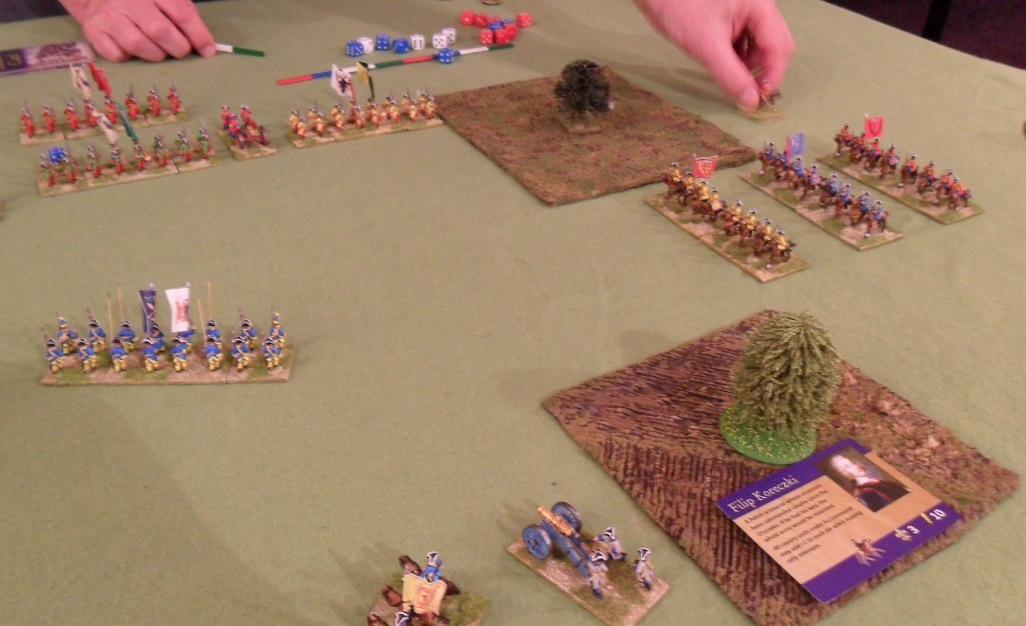

Luckily, I had enough cards to advance my cavalry to oppose the Russian flanking move.

 
Another view of the Swedish centre.  Sadly for the Swedes, the bold chappie who forced his way into the Russian line was overwhelmed. 


Both sides then took a couple of turns to re-arrange the lines and bring up supports.


By this time in the game, the Swedes has lost more units and their morale had dropped from 15 to 6.  Russian morale was 13 or 14.  We called a halt at this point with a Russian victory.

Here are a couple of final pictures from the Russian left. The cavalry duel between the woods was inconclusive, with the Swedes failing to defeat the Russians, even when using the Cavaliers card.


At the end of the night we'd had another great game of Maurice.  I was particularly pleased to see the fully painted armies on the table and I hope we can play again soon.   

For the future, we think we may need an army card or action cards to represent the Swedish GaPa.  And perhaps something to allow attackers that win an action to advance after combat. I'll work on those ideas.  In this game, the Swedes had the A la bayonette and Cavaliers cards, and the Russians had Steady lads. 

Next week is the final of the club ADG competition and my Wars of Roses army will be taking on the Scots-Irish.  

Workbench stuff

Here is a quick update on the workbench as I finished off the Swedish cavalry for the Great Northern War. 

The horses mostly done, with two finished regiments of troopers at the back.   


The rest of the cavalrymen, essentially finished at this stage - unless I spot something I've missed.    

 
The bases started with the wash coat of khaki.  I think a couple have had the first drybrush of sand, but I don't think it shows that well on my photo. 
 
 
And a side project, here's the Malifaux Pandora crew.  I've not had the chance to play Malifaux but I like some of their figures and they're nice to paint.  I bought these as part painted - the ghost-type figures were painted purple - so I'm going to lighten the top half of those figures.  I've started painting the Pandora figure, but still not sure about the colours to paint her dress and cloak. I'm favouring green, but was considering a blue / green combination. I'll post pictures of the finished crew at a later date. 
 
In the background of the photo are the Swedish command group for the Jonkopings regiment. I broke a standard and had to do a repair job.  I'm now thinking I should have replaced all the cast flagpoles with wire.


Next up will be the Great Northern War stuff in action.  
 
And at the club I've played another early Squad Leader scenario and my semi-final in our club ADG competition. 

Tuesday, 2 February 2016

games at the club

For the 3rd meeting in January I played the introductory scenario from an old favourite Avalon Hill game - Turning Point: Stalingrad.  The idea was to go through the scenario as a refresher on the rules, then to do the whole thing in February or March, playing using my double-sized map and counters. 

Last week I played a game of ADG with an old friend and valued opponent. This was not part of the club tourney, but just for the fun.  It was his Scots against my HYW English (my WoR figures doing the duty as stand-ins).  And this time I remembered the camera.

Here's the set up and first moves viewed from my right flank.  


And a closer view of my centre. The right hand knight is a stand-in I borrowed from my opponent because I only had one knight element in this box.   

And the left flank.  I had great faith in my swordsmen (ex-billmen) against the Scots spears, but it was unfounded. 

The lines are about to close of my left.  I deliberately held back on my right as I was hoping to win in the centre and left.  

Clunk - my swordsmen and foot knights clash with the spears.  The little dice in the marker holders are the number of disorders a unit has taken.  Light units take 2 before routing, mediums take 3 and the heavies, as here, take 4.   

This is a little later. Note the absence of swordsmen to the left of my foot knights.  I was unable to win a combat and unable to rally them - so, gone.  My knights however, have won against their knightly opposition and are pressing forward.

And here my opponent is measuring to bring his spears into contact with my centre bows. I held him for a time and the bows gave a good account of themselves, but the losses mounted and soon my left and then my centre crumbled. My right flank bows, amazingly enough, stood firm and routed a few spear units as well as causing casualties to most of the others.

Though I lost the battle, my opponent had the grace to call it more of a draw because I had caused him to lose some 19 out of an army total of 21.  
 
Elsewhere in the club, there was this game of FoGR, with some late renaissance German bunch taking on the Louis XIV French.  I think the French eventually won, though I recall hearing that the German artillery and cuirassiers did a good bit of damage.   
 

This pick up game of Commands and Colours Ancients was also under way. A game of ADG had been planned, but one chap couldn't make it.  Note here, the absence of Carthaginian units on the left. Shortly after this point the Romans achieved a victory.  

Elsewhere there was some multi-player Emperors of Europe type game going on, but I didn't take a photo. Next week is more ADG though I've still to arrange a specific game of something.

Sunday, 17 January 2016

Great Northern War Russians finally done

I've finally got enough finished for a game of Maurice.  Here's what they look like.

First, the whole lot, then closer views of the left, centre and right. This would amount to 106 points of trained regulars in a normal game of Maurice, though I'd probably use less than this in a game so I could buy some army cards.  (Games of Maurice are usually 100 points on each side) 


Another view of the centre.  

The cavalry

 
A view from the Swedish side of the table.  
 
And a similar view of the Swedes painted so far, as seen from Russian side of the table. This represents 51 points of trained units in a game of Maurice. 

And closer views of the Swedes.  


And the GNW stuff moves on ... with a laugh at what's next

Here are some pictures on my GNW stuff just as I get to final stages.  Also some photos of stuff in boxes which I thought about when a friend asked 'what's next?'. 

Here are the units, just missing flags and flock.


Now with the flags and flock. I've still to give the bases a good shake to get rid of the surplus. 


And in the background are the Swedish cavalry. Here are the horses so far. Still have a few manes and tails to do.      
 
 
After a friend asked 'what's next?', I had a good laugh, then thought I'd take a couple of pictures.
 
First, the Danes for the Great Northern War. 
 
 
Next, the Seven Years War Austrians.  The cavalry are stored under the foam, just to have everything in the one box.   
 
The Seven Years War French.  Again, the cavalry are stored under the foam.    
 
And the Seven Years War Prussians. The cavalry are stored under the foam. I tested a blue wash on the artillerymen, just to see the effect and if I could use it instead of paint or as a starting point for the tunics.        
 
And the rest of the Great Northern War stuff, Swedish at the top, then Russian infantry, dismounted dragoons and more artillery, then the rest of the Russian cavalry.    


And amusingly (or scarily) this doesn't include ancients, medieval, ECW, ACW, Flames of War and loads and loads of Napoleonics.  

First club games of the year

Had our first club games of the year. I meant to take photos, but my shaky hand meant the photos were a bit fuzzy. So just written comments for now.

First was ADG.  There were 3 club tourney games going on in the one night.  I was involved with a Wars of Roses civil war with Yorkist armies on both sides. It was touch and go for much of the evening, but my billmen managed to get amonst the enemy bow and eventually I won through. It was close though; I lost 2/3 of my army in disordered and routed units. 

The other games saw the Arabs defeat the Normans, though again at a cost. And the third game involved the Scots Irish defeating the Spanish / Granadines though at a cost of 21 disordered and routed units out of 23 in the army.

But all good games, and I think we're all starting to move beyond game mechanisms into tactics.  

Last week I was playing a new boardgame, Waterloo, Quelle affair! which a friend got though a kickstarter. He and another chap had played a couple of games. It was a hex game with division unit counters and driven by playing cards.  There were cards for each corps commander and some strategy cards, and you moved the units of a corps when you drew the appropriate commander card. There was another card which you could flip at any point in the turn to initiate combat, though once you had done your combat, that was you for the turn, even if your opponent still had several moves and his combat card still to play. Combat is a kind of buckets-of-dice approach, with one dice rolled for each strength point in an attack against one hex, and looking for 5's or 6's to hit.   

It was OK and an reasonably interesting game, but for me, it suffered in being a bit too close in style to Commands and Colors Napoleonics, though without CnCs tension and drama. I may play it again if offered, though it's so far down my list of things to play that I'll probably never play it.  Now, Commands and Colors Napoleonic is definitely on my list, specially after getting the recent Generals, Marshals and Tacticians expansion.  

Also at the club last week was an ADG game between the Arabs and the Spanish / Granadines / something (I really must find out!).  And four chaps had a Flames of War bash on the go; all mid-war armour.  I can't remember what else was on - some sci-fi game I think.

Next week is more ADG for some, but I'll be playing a Russian Front boardgame.  Still to decide which one, but it may well be my double sized version of Turning Point: Stalingrad.  I'll try to remember a camera and a stand so I can take photos.

Monday, 4 January 2016

GNW stuff

Over the Christmas period I was able to push on a bit more with the GNW Russians. 

The first pictures are just after the topping and tailing of tricornes, boots and scabbards. The figures are effectively finished, except for a final check on any details I've overlooked or messed up.  I've still to do buttons and lace on the drummers.   


Now a couple of pictures of the generals.  I watched the Poltava scene from the Sovereign's Servant again (it's on youtube somewhere). Interestingly in the film, Peter and his staff wore sashes with a very pale blue uppermost, then red then white. I did the sashes on my general figures per internet examples and uniform guides I have, with white uppermost, then blue then red.  I'm going to stay with what I have as it seems to be more accurate. 

(And isn't it interesting how we sometimes get involved in little details of figures and painting, often forgetting that in a game, no one is likely to notice the detail from 3 or 4 feet away across a table).    


Now the assembled units.  The rear rank figures were removed from temporary bases and added to the front rank.  Then the base round the rear rank figures were given the now usual finish of pva glue and scattered sand which is then painted over with any old paint just to better seal the sand. They are now starting to look like units.   

A couple of views from the rear also showing the mounted generals.  


Next for these figures will be to paint the bases, though as friends have already commented, a 'winter' effect has a charm all of it's own.  
 
And finally the red dragoons on the horses and bases I finished many months ago. I've just to pick a suitable standard for these chaps.  

And after I finish the bases and add the flags I'll move on to the Swedish cavalry. I've already done the brown coats on the horses, but the picture I took was a bit blurred from a shaky hand so I'll post better pictures next time. 

As a final note, I bought a little book by Pat Condray on the uniforms of the Great Northern War and in it, he has a comment that Swedish cavalry musicians rode grey horses. I think this is the only place I've seen the comment, though I'll have to read the Lars-Eric Hoglund books again.  I had thought grey horses for musicians was a later 18c development.  If anyone has any definite information one way or the other, please let me know (though I don't think I'll be repainting the horses of the 8 Russian musicians I've already done).